Google AI Mode Ads: What B2B and SaaS Advertisers Should Do Now
Google is rolling out ads inside AI Mode conversations, including follow-up questions in the US, with no separate opt-out and no separate reporting. Here is how it works and how B2B and SaaS advertisers should respond.
 Taimoor AliDigital Marketer
Google is rolling out Google AI Mode ads in more places, and in the US they now reach beyond the first question. With multiturn ads, a sponsored result can appear on a follow-up question halfway through a conversation in AI Mode. For B2B and SaaS companies, where buyers ask long, specific questions before they book a demo, that changes which queries your ads can match and how much control you have. This guide covers what Google announced, how matching works, what you cannot control, and the practical changes to make in your account.
What Google announced
In October, Google announced two changes: ads in AI Mode for ten more English-language countries, including Australia, Canada, New Zealand, and Singapore, and multiturn ads in the US. As Search Engine Journal reported, Google shared the expansion update from its Google Ads account on November 9. The UK, Brazil, and Mexico are planned for the fourth quarter of 2026.
Shashi Thakur, Google's VP and general manager for Search Ads, described the change directly: "To allow ads in follow-up queries in AI Mode, we are launching multiturn ads in the US," as MarketingTechNews reported. Google says these ads are labeled Sponsored and can appear within or alongside AI-generated responses.
Google also says AI Mode queries are about three times longer than traditional searches, based on its own US research. Longer questions carry more context, and that context is what the ads now match on.
How ads get into an AI Mode conversation
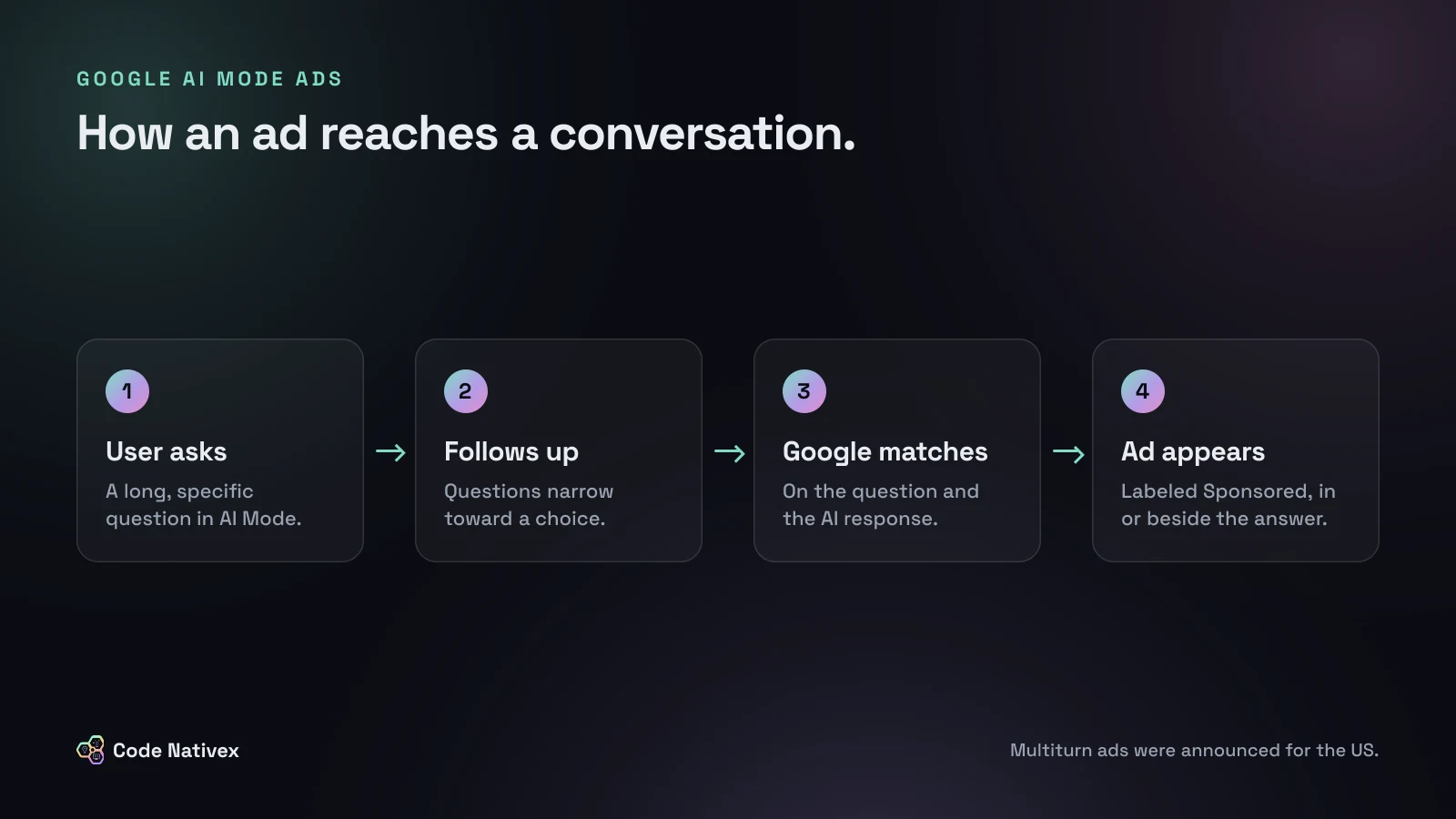
According to Google's documentation, as reported by MarketingTechNews, there are two ways an ad can match:
- Direct matching to a query that expresses commercial intent, similar to a normal search.
- Contextual matching that considers both the user's question and the AI response, for intent that appears partway through a conversation.
Which one your campaign can use depends on its settings:
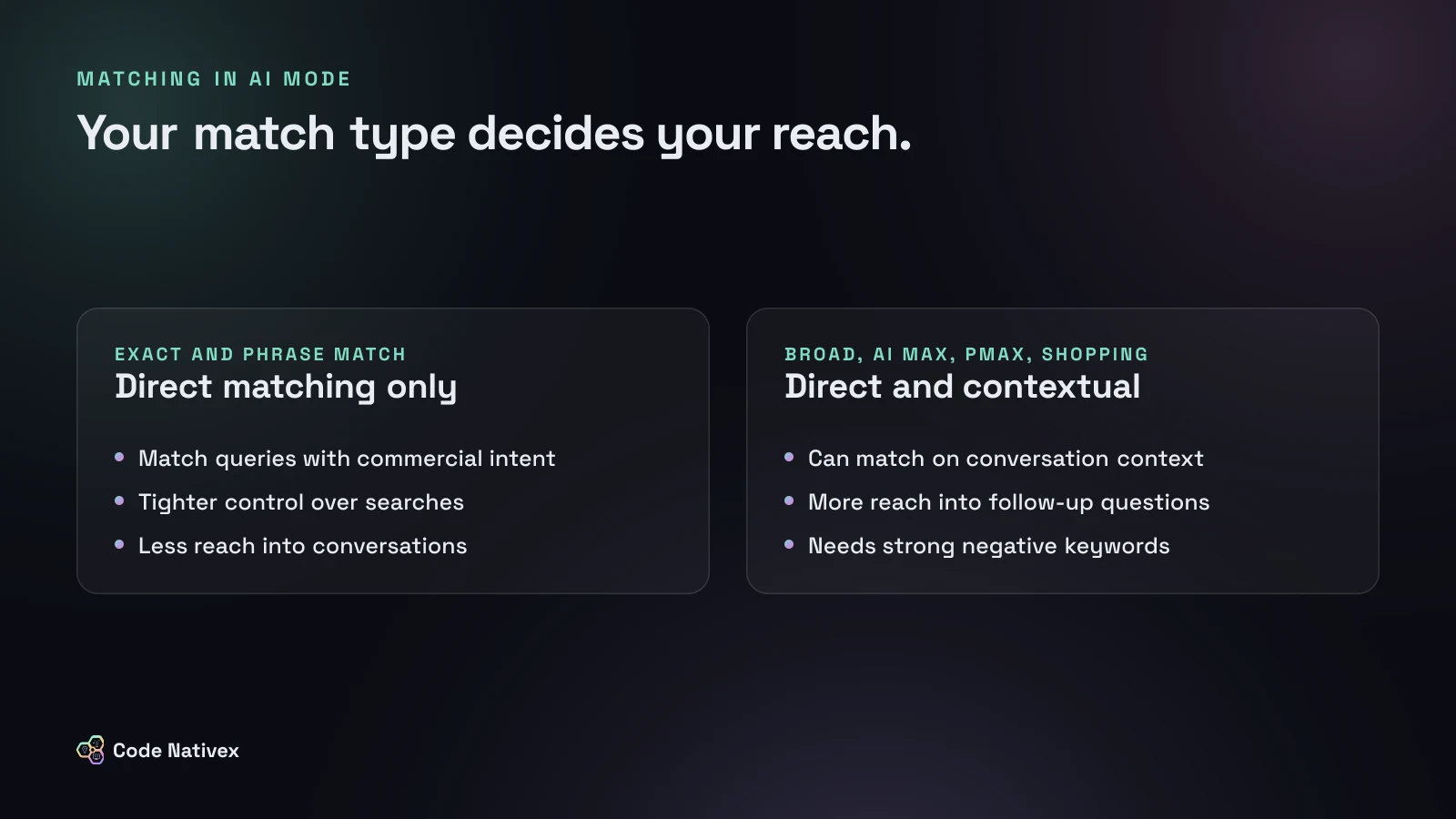
Ads use the same auction and the same cost-per-click or conversion-based bidding as standard Search ads, and Google says there are no additional fees. Google's own ads in AI Mode page describes the new formats as powered by AI Max and Performance Max.
What you cannot control
This is the part that matters most for budget owners:
- No separate targeting. You cannot target AI Mode on its own, and you cannot exclude it while still running on Google Search.
- No separate reporting. AI Mode impressions, clicks, conversions, and cost are included in your standard reports. There is no AI Mode segment and no breakdown by conversation turn.
- Search terms are approximate. Search Engine Journal notes that search terms for these conversations may approximate the user's intent rather than show their exact words.
- AI-written context. Google can show AI-generated explanations next to sponsored listings, and advertisers cannot write, edit, or approve them.
What you still control: negative keywords, brand exclusions, your bids and budgets, and above all the page people land on.
What B2B and SaaS advertisers should change
Ecommerce advertisers get most of the attention in AI Mode coverage, because Shopping carousels are easy to picture. For software companies, the change is quieter but real: a buyer comparing tools in a conversation can now see your ad on question three, not just question one. Here is how to prepare.
1. Tighten negative keywords. Contextual matching can put your ad next to research questions with no buying intent, such as students, job seekers, or people looking for free tools. Review search terms weekly for the next month and add negatives for the patterns you do not want.
2. Decide where broad match and AI Max belong. If you want reach into conversational queries, test broad match or AI Max in a separate campaign with its own budget cap. Keep your core high-intent terms in exact and phrase match, where you keep tighter control.
3. Build landing pages for specific questions. Someone who reached your ad after asking about integrations or security reviews expects a page that answers that question, not your generic homepage. Pages for each use case, integration, and comparison convert better from long, specific queries. Our technical SEO checklist for SaaS websites covers the speed and structure those pages need.
4. Measure lead quality, not just leads. Because you cannot separate AI Mode traffic, send qualified-lead and closed-deal data from your CRM back to Google Ads as conversions. That way automated bidding optimizes toward customers, not form fills from curious researchers.
5. Watch cost per qualified lead by landing page. With no AI Mode segment, landing page and search term trends are your best signals of whether this traffic is helping.
Paid and organic now share the same answers
AI Mode ads appear in the same conversations where Google's AI cites organic sources. A buyer may see your brand cited in the answer and your ad beside it, or a competitor in both places. Our guide to Google AI Overviews for SaaS explains how those AI features choose organic sources, and our post on the Google November 2026 core update covers the ranking changes rolling out at the same time. Paid and organic teams should look at the same queries together this quarter.
How we help SaaS teams with paid traffic
Ads only work as well as the page they send people to. We build fast, focused landing pages and marketing sites that load quickly, answer specific buyer questions, and pass conversion data cleanly to analytics and ad platforms. Our web app development service covers marketing sites as well as product builds.
The bottom line
Google AI Mode ads now reach follow-up questions in the US, matched on conversation context, with no separate opt-out and no separate reporting. For B2B and SaaS advertisers, the right response is control where you still have it: sharper negative keywords, deliberate use of broad match and AI Max, landing pages built for specific questions, and conversion data from your CRM.
Want help building landing pages that convert paid traffic? Contact us and we will take a look.
Frequently asked questions
- What are multiturn ads in Google AI Mode?
- Multiturn ads are ads that appear on responses to follow-up questions in an AI Mode conversation, not only on the first query. Google announced them for the US in October 2026 and says they are labeled Sponsored.
- Can I opt out of Google AI Mode ads?
- Not separately. Eligible Search, Shopping, Performance Max, and AI Max campaigns can serve in AI Mode automatically, and you cannot exclude AI Mode while still running on Google Search. Negative keywords and brand exclusions still apply.
- Can I see how my ads perform in AI Mode?
- Only in aggregate. Impressions, clicks, conversions, and cost from AI Mode are included in your standard campaign reports, but Google does not offer a separate AI Mode segment or a breakdown by conversation turn.
- Do Google AI Mode ads cost more?
- Google says ads in AI Mode use the same auction and the same cost-per-click or conversion-based bidding as standard Search ads, with no additional fees.
- Is AI Mode ads available in the UK?
- According to Search Engine Journal and MarketingTechNews, Google plans ads in AI Mode for the UK, Brazil, and Mexico in the fourth quarter of 2026. Multiturn ads were announced for the US.
Written by
Taimoor Ali
Digital marketer at Code Nativex, focused on growth through SEO, ads, and content strategy.
Meet the team