Google November 2026 Core Update: What It Means for Your Site and What to Do Now
Google's third core update of 2026 started rolling out on November 10 and runs into the holiday season. Here is what Google said, how to measure it properly, and what to do if your rankings move.
 Taimoor AliDigital Marketer
Google started rolling out the Google November 2026 core update on November 10, and rankings will move for the next two weeks. For SaaS companies and agencies, the timing is awkward: the rollout is expected to end just before Thanksgiving, Black Friday, and Cyber Monday, when traffic patterns change anyway. This guide covers what Google said, what to do while the update rolls out, how to read your data around the holidays, and what Google itself recommends if your pages drop.
What Google announced
Google posted the update on its Search Status Dashboard on November 10, saying it applies globally and to all languages. As Search Engine Journal reported, Google added on LinkedIn that this is a regular update meant to surface relevant, satisfying content from all types of sites, and that it may take up to two weeks to complete. That puts the likely end around November 24.
Google gave no specific new guidance for this update. That is normal for core updates: they are broad changes to how Google ranks pages, not a new rule you can comply with.
It is the third core update of 2026. The earlier two rolled out in about twelve days each:
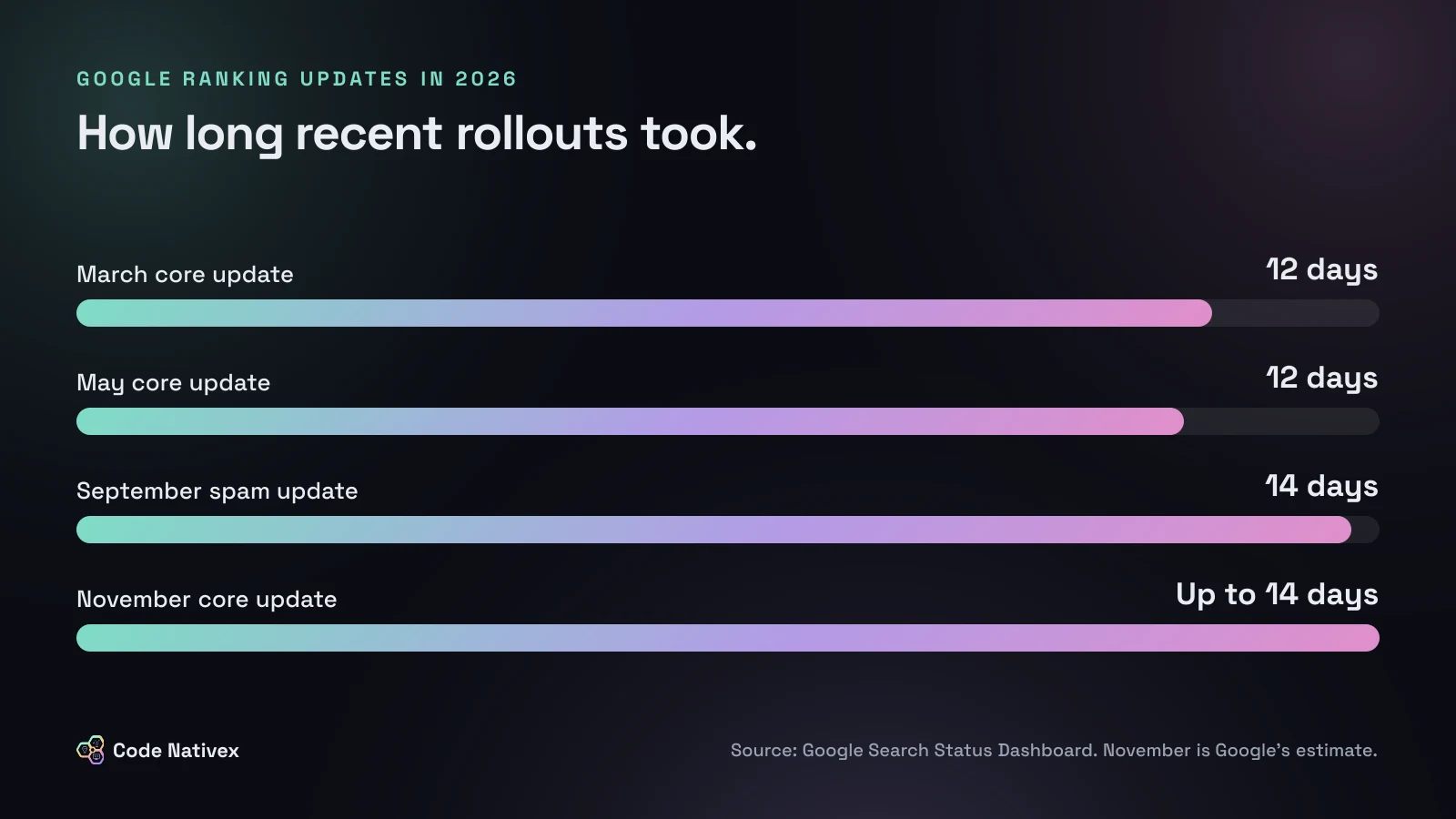
- March 2026 core update: started March 27 and took about 12 days.
- May 2026 core update: started May 21 and took about 12 days.
- September 2026 spam update: started September 24 and took about 14 days.
Spam updates are different from core updates. They target specific spam practices, while core updates reassess how well pages answer searches in general. If your traffic fell in late September, look at that drop separately from anything that moves now.
What to do while it rolls out
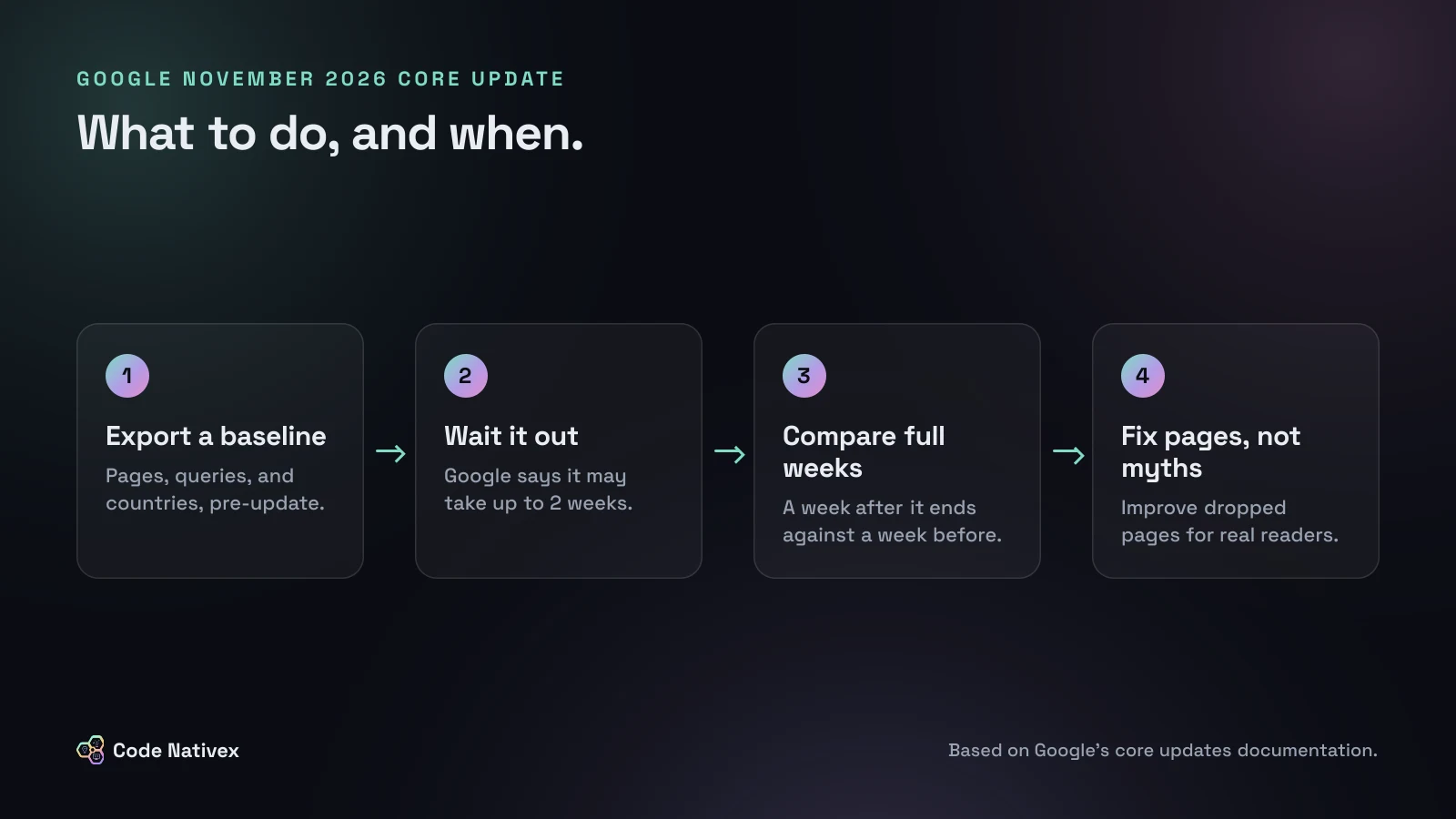
Export a baseline today. In Search Console, open the Performance report and export clicks, impressions, and average position by page, by query, and by country for the weeks before November 10. Search Console keeps your history, but a saved export makes later comparisons quicker and gives you a clean before-and-after record.
Note your own changes. Write down anything you ship during the rollout: new pages, redirects, template changes, or a site migration. Otherwise you will not know whether a movement came from Google or from you.
Do not panic over daily swings. Rankings often move up and down several times during a rollout. A drop on day three can reverse by day ten.
Hold big structural changes. Keep publishing and keep fixing obvious problems, but leave large redesigns, URL changes, and content deletions until the rollout ends.
How to read your data around the holidays
Google's core updates documentation recommends waiting at least a full week after an update completes, then comparing that week with a week before the rollout began. If the rollout ends around November 24, your first clean week after it runs straight into US Thanksgiving on November 26, Black Friday, and Cyber Monday.
That changes behavior for most sites:
- E-commerce and consumer apps usually see demand rise, which can hide a ranking loss.
- B2B SaaS often sees searches fall over the US holiday week, which can look like a ranking loss when it is not.
To separate the two, look at average position and impressions by query, not just clicks. If your positions held but clicks fell, the cause is likely demand. Comparing with the same weeks last year helps too, if you have the data. For a clean read, many teams compare the first full week of December with the week before November 10.
Google also suggests checking your top pages and queries and splitting results by search type, such as Web, Images, and News. A small move, such as from position 2 to 4, does not call for drastic action. A large drop across many pages does.
If your pages drop
Google says core updates do not target specific sites or individual pages. A page that drops has usually been outranked by pages that now serve searchers better. Its advice for a large, sustained drop is consistent:
- 1.Review the site as a whole. Ask whether it is helpful, reliable, and written for people first, not only whether individual pages are.
- 2.Study the pages that fell. Compare them with the pages that now outrank them. Are they more current, more specific, or written by someone with more first-hand experience?
- 3.Get outside opinions. Someone who did not write the page will see its weaknesses faster.
- 4.Avoid quick fixes. Google warns against changes made for SEO myths. Improve the content for readers instead, for example by updating facts, adding real examples, and restructuring it so it is easier to read.
- 5.Delete only as a last resort. Removing content can help when it was made for search engines rather than people, but it is not the first move.
Be patient. Google says some changes show results within days, but it can take several months for its systems to confirm that a site has improved, and sometimes the effect only shows after the next core update. Google also makes smaller core updates continually, so genuine improvements can pay off before then.
Where SaaS sites should look first
For a software company, a handful of page types carry most of the commercial traffic. Check these first:
- Comparison and alternative pages, which often compete with review sites and forums.
- Pricing, integrations, and security pages, which buyers search for by name.
- Documentation and help center pages, which often rank for long, specific queries.
- Blog posts targeting buyer questions, especially older posts with outdated facts.
The same work helps in AI answers as well as classic results, because Google says its AI features use the same core ranking systems. Our guide to Google AI Overviews for SaaS explains how those features choose sources, and our technical SEO checklist for SaaS websites covers the crawl, speed, and structure basics that every page needs before content quality can count.
How we approach content on our own site
We hold our own blog to the standards Google describes: each post names its author, links the primary sources for its facts, such as official release notes and documentation, and is updated when those facts change. On client websites, our web app development service builds fast, server-rendered marketing sites that are easy for both readers and search engines to use.
The bottom line
The Google November 2026 core update started on November 10 and should finish around November 24, just before the US holiday rush. Export your baseline now, avoid big changes during the rollout, and judge the results on positions and impressions after a full week, with the holidays in mind. If pages drop, improve them for readers and give it time.
Want a second opinion on how your site came through the update? Contact us and we will take a look.
Frequently asked questions
- When did the Google November 2026 core update start?
- Google started rolling it out on November 10, 2026, according to its Search Status Dashboard. Google says it applies globally and to all languages, and may take up to two weeks to complete.
- How many core updates has Google released in 2026?
- Three: the March 2026 core update, the May 2026 core update, and the November 2026 core update. Google also released spam updates in March, June, August, and September.
- My traffic dropped. Is my site being penalized?
- Google says core updates do not target specific sites or pages. A drop usually means other pages now serve searchers better. Wait for the rollout to finish, compare a full week after it with a week before, and look at which pages and queries changed.
- How long does it take to recover from a core update?
- Google says some improvements show results within days, but it can take several months for its systems to confirm a site has improved. Sometimes the effect only shows after the next core update.
- Should I change my site during the rollout?
- Keep publishing and fixing obvious problems, but avoid large structural changes until the rollout ends. Otherwise you cannot tell whether a change in traffic came from the update or from your own edits.
Written by
Taimoor Ali
Digital marketer at Code Nativex, focused on growth through SEO, ads, and content strategy.
Meet the team