Google AI Overviews for SaaS: How to Get Your Product Cited in 2026
AI Overviews and AI Mode now answer many of the questions your buyers ask. Here is what Google itself says decides which sites get cited, and what a SaaS website should do about it.
 Taimoor AliDigital Marketer
When a buyer asks Google "what is the best way to sync Stripe data to Postgres" or "how much does a SaaS MVP cost", the first thing they often see now is an AI answer with a handful of cited sites. For a software company, Google AI Overviews for SaaS is no longer a side topic: being one of those citations is the new top of the funnel. This guide explains how AI Overviews and AI Mode choose their sources, what changed on October 15, what Google says you can safely skip, and the specific pages a SaaS website should get right.
How AI Overviews and AI Mode choose their sources
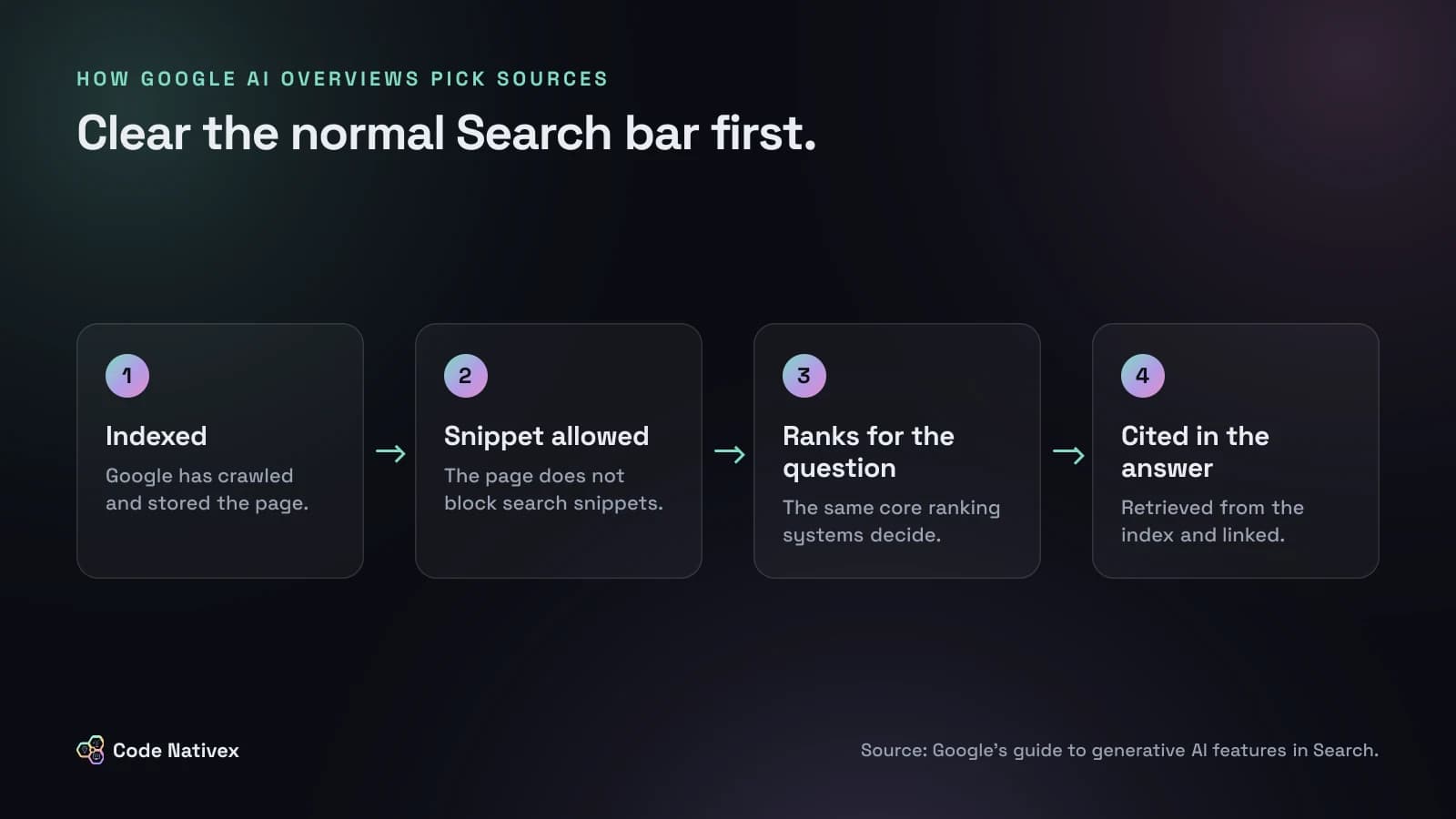
Google's own guide to optimizing for generative AI features, last updated on July 10, 2026, is unusually direct. AI Overviews and AI Mode are rooted in Google's core Search ranking and quality systems. They retrieve pages from the regular Search index and build the answer from them.
That has three practical consequences:
- 1.The page must be indexed. If Google has not indexed it, it cannot be retrieved.
- 2.The page must be eligible for a snippet. Pages that block snippets cannot be shown as a source.
- 3.The page must rank for the question. In practice, a page that sits on page six for a query is unlikely to be pulled into the answer for it.
Google is also clear that indexing and serving are not guaranteed. There is no switch to flip and no separate submission process.
What changed on October 15
On October 15, 2026, Google announced updates to AI Mode and AI Overviews that matter for any business with a website:
- More inline links, placed higher. Links embedded in the words of an AI answer are now more common and appear higher in responses.
- A test of an "official websites" section. For some tasks, Google is testing a section at the top of AI responses that highlights the one or two official sites for that task or piece of information, with a note on why each link is useful.
- More visible related links. Links at the end of some answers now show image thumbnails and a more clickable design.
The second point is the one to plan around. If someone asks about your product's pricing, integrations, or security, you want your own site to be the obvious official source, not a review site or a reseller's page.
What Google says you can skip
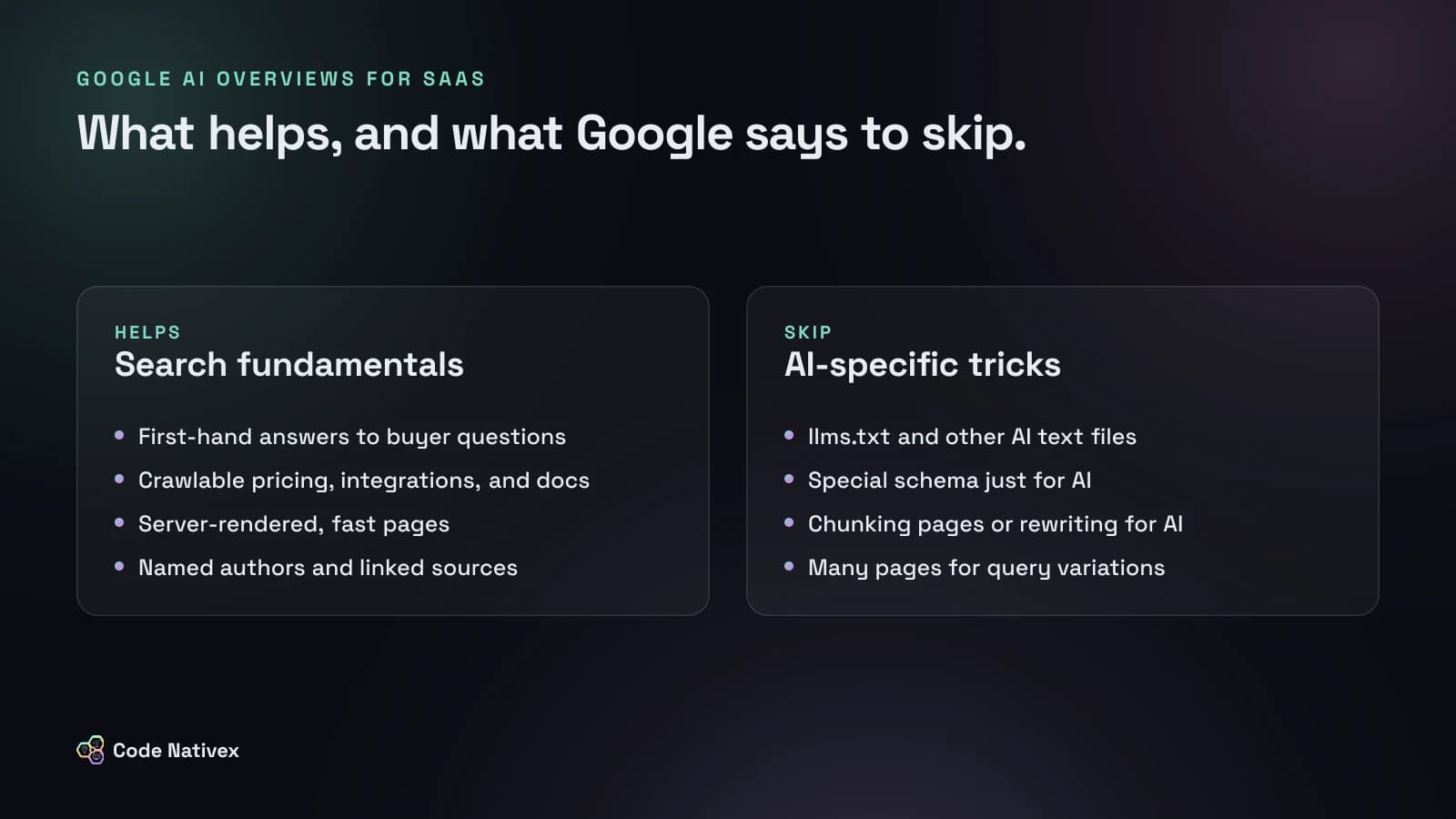
A whole industry now sells "AEO" and "GEO" services. Google's guide lists several tactics you do not need for its generative AI features:
- llms.txt files and other AI text files. Google says Search does not use them. We publish an
llms.txtfile on our own site for other tools, but it plays no part in our Google plan. - Special schema markup. No special structured data is required for these features.
- Chunking content into small pieces. There is no ideal page length.
- Rewriting content for AI. The systems understand synonyms and general meaning.
- Inauthentic mentions. Planting your brand name around the web does not help.
Google also warns that creating many pages for slight query variations, in an attempt to influence AI answers, is a spam risk. That matches its long-standing position on scaled, low-value content, which we also cover in our technical SEO checklist for SaaS websites.
What actually helps a SaaS website
The guide's positive advice is short: create helpful, non-commodity content with a real point of view, meet the technical requirements, give people a good page experience, and support text with relevant images and video. Here is what that means for a software company.
Answer the questions buyers actually ask. Buyers research software with comparison, cost, "how do I", and "should I" questions. Write a page that answers one question completely, with first-hand detail: the steps you follow, the trade-offs you have seen, the numbers from a source you link to.
Make your official pages the source of truth. With Google testing an official websites section, your own pages should be the clearest place to learn the facts about your product:
- a pricing page that states plans and limits in plain text, not only in images
- an integrations page with one indexable section per integration
- a security page that names your standards, such as SOC 2 or GDPR, accurately
- documentation and a changelog that can be crawled without logging in
Keep pages eligible for snippets. It is easy to block this by accident. Check that you are not using nosnippet or a low max-snippet value on pages you want cited. In a Next.js app, this is set in metadata. Our own root layout allows full-length snippets:
// app/layout.tsx
export const metadata: Metadata = {
  robots: {
    index: true,
    follow: true,
    googleBot: {
      index: true,
      follow: true,
      "max-snippet": -1,
      "max-image-preview": "large",
    },
  },
};
Render the content on the server. If your headline and answers only appear after JavaScript runs, Google has to come back to render them. Server-rendered pages are easier to crawl and quicker to index.
Show who wrote it. Name the author, explain their experience, and link your sources. It is the same signal that makes a human reader trust a page.
A checklist for SaaS marketing sites
- 1.Every page you want cited is indexed. Check URL Inspection in Search Console.
- 2.No
nosnippetor restrictivemax-snippetvalues on those pages. - 3.Each important buyer question has one strong page, not ten thin variations.
- 4.Pricing, integrations, security, and docs are crawlable text, kept up to date.
- 5.Marketing pages are server-rendered and fast on mobile.
- 6.Authors are named, and facts link to primary sources.
- 7.Structured data is accurate and matches what the page shows.
- 8.One canonical domain, with permanent redirects from every variant.
How to measure it
Rank trackers cannot see AI answers reliably, so start with Google's own data. Google's guide points site owners to the Generative AI performance report in Search Console, which shows visibility in AI features in Search and Discover.
Also watch the signals around it: branded searches, demo requests, and the pages people land on before they contact you. On our own site, Search Console flagged our guide to AI agents for SaaS for getting more impressions than usual within a week of publishing. We responded by expanding it to answer the exact questions it was appearing for, which is the loop that works: publish, read the queries, improve the page.
How we approach this on client websites
We build SaaS marketing sites the same way we build products: server-rendered, fast, and structured around the questions buyers ask. Our web app development service covers the build, and our guide to the best tech stack for SaaS explains why server-rendered frameworks are our default. For examples of what we ship, see our portfolio.
The bottom line
There is no secret formula for Google AI Overviews. Google says plainly that its AI features run on the same ranking systems as the rest of Search. For a SaaS company, that means getting indexed, staying eligible for snippets, answering real buyer questions better than anyone else, and making your own site the most reliable source of facts about your product.
Want a technical review of how your SaaS website shows up in search? Tell us about your site and we will send a fixed-scope proposal.
Frequently asked questions
- How do I get my SaaS website into Google AI Overviews?
- Get the basics right first: pages must be indexed, allowed to show a snippet, and rank for the question. Then publish clear, first-hand answers to the questions buyers ask, and keep your pricing, integrations, security, and docs pages accurate and easy to crawl.
- Do I need an llms.txt file for Google AI Mode?
- No. Google's guide for generative AI features says Search does not use llms.txt files or other AI-specific text files, so they do not help you appear in AI Overviews or AI Mode.
- Is optimizing for AI Overviews different from SEO?
- Mostly no. Google says these features are rooted in its core Search ranking and quality systems. Helpful content, technical health, and a good page experience are still what matter.
- Can schema markup get my pages into AI Overviews?
- Google says no special schema is required for generative AI features. Keep using structured data where it earns normal rich results, and make sure it matches what the page shows.
- How do I see traffic from AI Overviews?
- Google points site owners to the Generative AI performance report in Search Console, which shows visibility in AI features in Search and Discover.
Written by
Taimoor Ali
Digital marketer at Code Nativex, focused on growth through SEO, ads, and content strategy.
Meet the team