AI Agents That Do the Work,With a Human in Control
Code Nativex offers AI agent development services for teams in the US and UK that want automation they can trust. We build custom agents that read your documents, work inside your CRM and Slack, qualify leads, and run multi-step workflows, with human approval wherever a mistake would cost you.
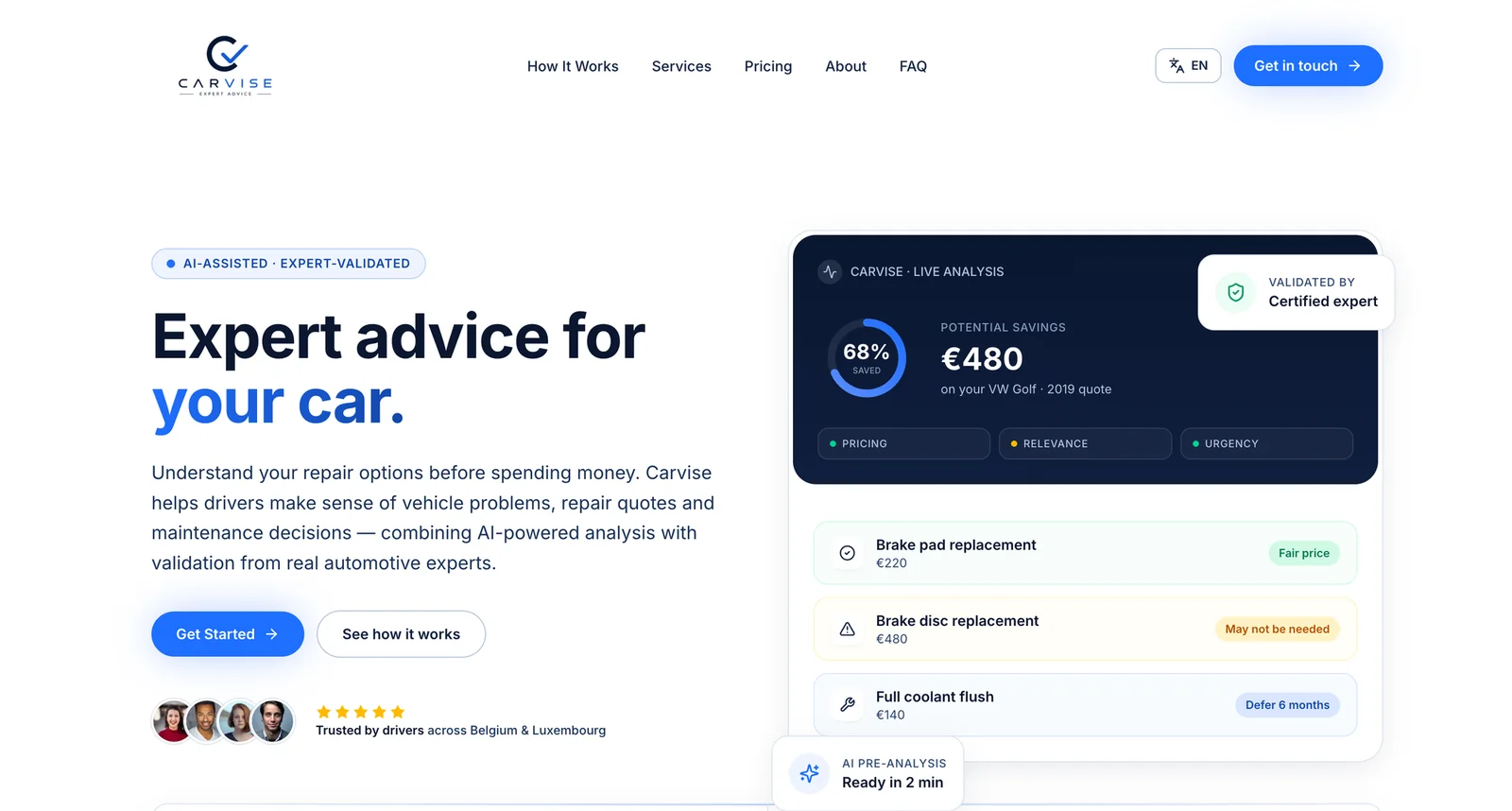
- AI pre-analysis per quote on Carvise
- ~2 min
- Expert sign-off on every Carvise result
- <24h
- Of Carvise quotes flagged as overpriced or unneeded
- 68%
- Of the code and IP owned by you
- 100%
A chatbot answers questions. An agent finishes the job.
An AI agent is a language model that can take actions. It reads the inputs, decides which steps to take, and calls your systems to complete a task, such as qualifying a lead, pulling the key fields out of a contract, or drafting a reply from your help docs. Done well, it removes hours of repetitive work. Done badly, it makes confident mistakes at scale.
The difference is engineering, not the model. Most of an agent build is ordinary product work: choosing the one job it owns, exposing your systems as safe, narrow tools, handling failures, and measuring results against real cases. The model call is the quick part.
We design agents so people stay in charge of the decisions that matter. On Carvise, an AI pre-analysis reads a repair quote in about two minutes, and a certified expert confirms, corrects, or overrides every result before a driver sees it. Fast automation with accountable sign-off is the pattern we start from.
Agents also need looking after. Models are retired, APIs change, and integrations break. We document the prompts, tools, and approval rules so the agent can be tested and updated, and you can keep it maintained on a monthly retainer after launch.
Agents for the work your team repeats every day.
Narrow, measurable jobs first. Each agent works inside the systems you already use.
Multi-step agents
Agents that plan and carry out a sequence of steps across your systems, with a log of every action and an approval gate on anything that writes, sends, or spends.
Lead qualification bots
Agents that research and score inbound leads against your criteria, then pass the promising ones to your sales team with the context attached.
Document processing
Read quotes, contracts, invoices, and forms, extract and check the fields that matter, and flag anything unusual for a person to review.
CRM and Slack integrations
Agents that work where your team already works: updating CRM records, posting summaries in Slack, and asking for approval in the thread.
RAG and vector search
Answers grounded in your own documents and data through retrieval, so the agent works from what your business knows instead of guessing.
OpenAI and LangChain integration
Production integrations with the OpenAI API and LangChain that return structured output your code can validate before anything is acted on.
Human review queues
Queues where a person confirms, corrects, or overrides the agent before results go out, like the expert review queue we built for Carvise.
Fine-tuning and predictive analytics
Custom model fine-tuning and predictive analytics for the cases where a general-purpose model is not accurate enough on its own.
One narrow job first, then expand.
The first agent should do one frequent, checkable task well. Once it has earned trust on real cases, it can take on more.
- 01Week 0
Pick the job
A 30-minute call to find the task worth automating: frequent, multi-step, and easy to verify. You get a fixed-scope, fixed-price proposal for that job.
- 02Week 1
Tools and guardrails
We define what the agent can read, what it can change, and where a person approves. Tools act with the user's own permissions, never as a superuser.
- 03Weekly
Build and test on real cases
We build against real examples from your business and ship weekly to staging, so you can test the agent on your own cases before it touches production.
- 04Launch
Launch and monitor
Production rollout with every step logged, plus documentation of the prompts, tools, and approval rules. All of it lives in your repository.
Default stack
- OpenAI API
- LangChain
- RAG
- Vector search
- Next.js
- TypeScript
- Node.js
- PostgreSQL
- Slack
- CRM APIs
AI in production, with people accountable.
An AI pipeline with expert sign-off, and the automation work that shows what removing manual steps is worth.
Know which task you want off your team's plate?
Tell us the job, the systems involved, and what a mistake would cost. We will reply with a fixed-scope, fixed-price proposal for the agent.
What to ask an AI agent development company.
A demo proves very little. These questions show whether an agent will survive contact with your real work.
- 01
How does the agent fail?
Every agent makes mistakes. A good partner can tell you exactly what happens when it does: what gets logged, who gets alerted, and when a person takes over.
- 02
Which actions need human approval?
Reading data is low risk. Writing records, sending messages, and spending money should need a person's sign-off until the agent has earned trust on real cases.
- 03
Will it work inside our existing systems?
An agent that only runs in a sandbox is a prototype. Ask how it connects to your CRM, Slack, documents, and product, using the permissions you already have.
- 04
Who owns the code and prompts?
You should. We assign the code and IP to you, keep it in your repository, and document the prompts and tools so another team could take over.
- 05
What happens when the model changes?
Providers retire models on a schedule. Ask how the agent is tested, so a model swap can be checked against real cases before it reaches users.
AI agent development questions, answered.
01What is the difference between an AI agent and a chatbot?
A chatbot answers questions. An agent takes actions: it decides which steps to take and calls your systems, such as your CRM or document store, to finish a task. That is why an agent needs permissions, approval gates, and logging that a chatbot does not.
02Do we need to train our own AI model?
Usually not. Most agents call a hosted model such as the OpenAI API and ground it in your data with retrieval. We fine-tune a custom model only when a general-purpose one cannot do the job accurately.
03How do you stop an AI agent from making costly mistakes?
Narrow permissions, read-only tools first, human approval for anything that writes, sends, or spends, and a log of every step. On Carvise, a certified expert reviews every AI result before it is published.
04How is an AI agent project priced?
Like every build, on its scope. After the first call you get a fixed-scope, fixed-price proposal for the agent's first job, so you know the cost before any work starts.
05Can you add an AI agent to our existing product?
Yes. We regularly work inside existing codebases and alongside in-house teams. For an existing product we start with a paid one-week discovery before committing to a scope.
Guides from our engineers.
Practical articles on the decisions behind this kind of build.
More from the same senior team.
Design, engineering, and AI under one roof, so nothing gets lost between handoffs.