Flutter vs React Native for Startups: How to Choose in 2026
Both frameworks have changed a lot since 2024. Here is how Flutter and React Native compare for a startup today, and the questions that should decide it.
 Raja ZiafatCEO & Founder
Every startup that needs a mobile app hits the same fork early: Flutter vs React Native for startups is still the most common question we hear on discovery calls. Both let one team ship iOS and Android from a single codebase. Both are mature. The choice still shapes your hiring plan, your design freedom, and how much code your mobile and web products can share for years. This guide covers what changed recently, how the two compare where it matters, and a simple rule for deciding.
What changed since 2024
If your opinion of either framework was formed a few years ago, it is probably out of date.
React Native finished its rewrite. The React Native 0.82 release in October 2025 was the first version to run entirely on the New Architecture. That architecture replaced the old asynchronous bridge between JavaScript and native code, which was the root cause of most "React Native is slow" complaints. Later releases have kept removing legacy code.
Flutter replaced its rendering engine. Flutter's Impeller renderer is now the default on iOS and on most modern Android devices. It was built to remove the first-run animation stutter that some Flutter apps used to show.
The practical result: the performance gap that used to dominate this comparison has mostly closed. The decision now turns on team, product, and roadmap.
How they compare where it matters
Performance. For standard startup products, such as marketplaces, booking apps, dashboards, and companion apps for a SaaS product, both are fast enough that users will not notice a difference. Flutter still has an edge for heavy custom animation, games, and canvas-style interfaces, because it controls every frame itself.
User interface. Flutter draws its own widgets, so the app looks identical everywhere. That is ideal for a strongly branded, custom design. React Native uses real native components, so the app looks and behaves like a native iOS or Android app by default, which users often prefer for everyday utility apps.
Hiring. React Native uses JavaScript or TypeScript and React, which most front-end developers already know. Flutter uses Dart, which has a smaller talent pool. For a startup that will hire its own team later, this is often the deciding factor.
Code sharing. React Native can share types, validation, API clients, and business logic with a React or Next.js web app. Flutter can target the web, but it is a weaker fit for content-heavy or search-sensitive sites.
Tooling. Expo has become the standard way to build and ship React Native apps, including over-the-air updates. Flutter's tooling is excellent and very consistent across platforms.
Long-term upkeep. Both frameworks release several times a year, and app stores raise their minimum requirements regularly. Budget a few days per quarter for framework and dependency upgrades whichever you choose. Teams that skip upgrades for a year end up paying for a painful migration instead.
The question that usually decides it
In practice, one question settles most cases: do you have, or plan, a web app built with React?
If yes, React Native lets one team work across web and mobile, share real code, and move people between projects. Over a couple of years that saves more time than any framework benchmark.
If your product is mobile-first, the brand experience is the product, and you have no React web app to share with, Flutter's design freedom becomes the bigger advantage.
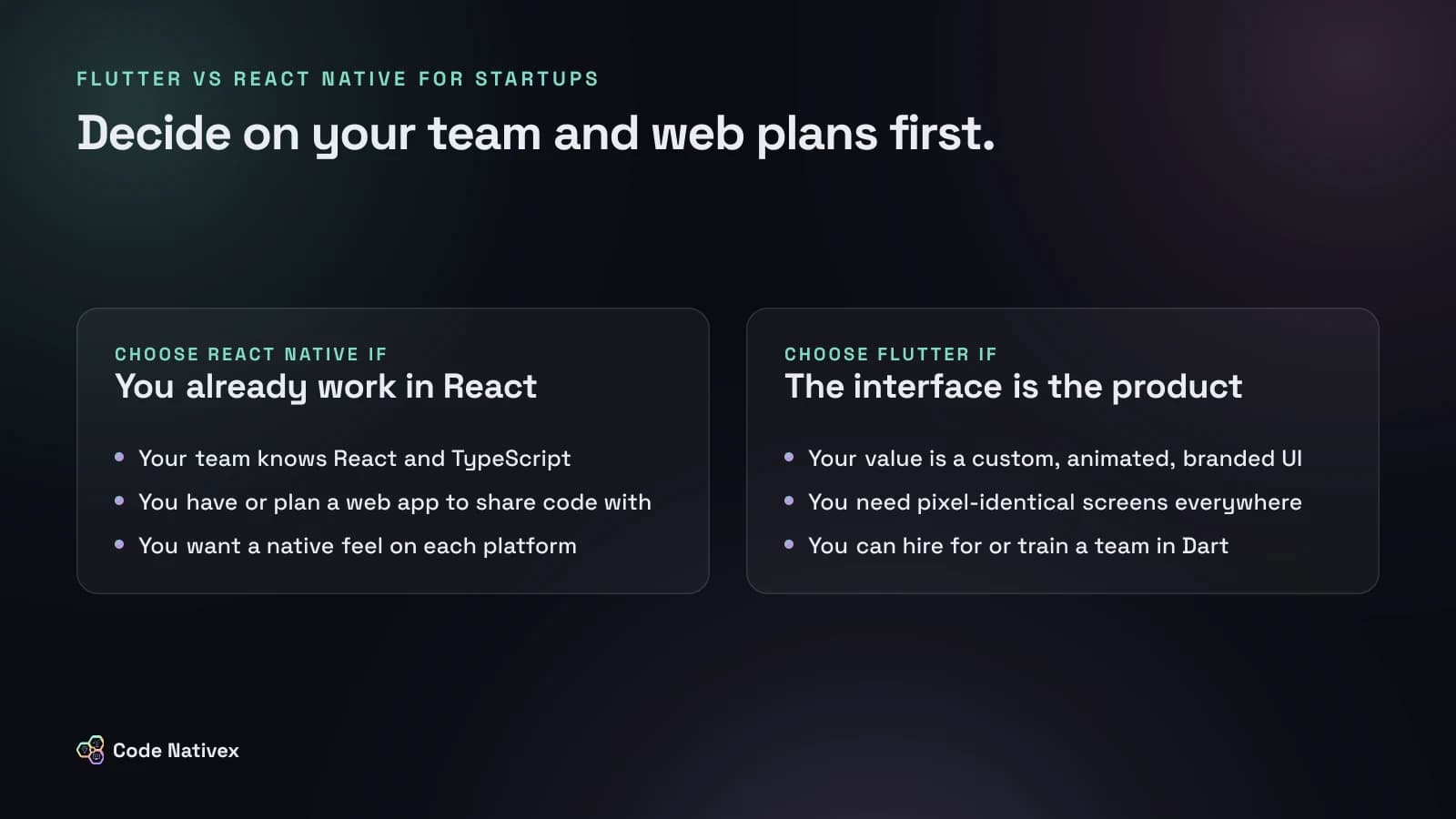
When to choose Flutter
- The product's value lives in a custom, animated, highly branded interface.
- You need pixel-identical behavior across iOS, Android, and other targets like desktop or embedded screens.
- You are comfortable hiring for, or training a team in, Dart.
- You do not need to share code with a React web app.
When to choose React Native
- Your team already knows React and TypeScript.
- You also have, or plan, a web app and want to share code and people.
- You want the app to feel native on each platform by default.
- Getting an MVP into users' hands quickly is your main constraint.
- You want the largest possible ecosystem of libraries and services.
A quick decision checklist
Answer these five questions before you commit:
- 1.Team: who will maintain this app in two years, and what do they already know?
- 2.Web: will a React web app share logic, types, or users with this app?
- 3.Design: is the interface a standard product UI, or a custom brand experience?
- 4.Native features: do you need unusual hardware access that only one ecosystem supports well? Check the specific libraries now, not later.
- 5.Release cadence: do you need over-the-air updates for fast fixes? Expo makes this straightforward on React Native.
If most answers point to React and the web, choose React Native. If they point to a custom, mobile-only experience, choose Flutter.
How we decide on client projects
Our mobile developer works in both React Native and Flutter, so we do not have a framework to sell. On client work we start from the team and the product. When a company already runs a React or Next.js web app, React Native is almost always our recommendation, because the web and mobile work can share code and people. That is the same thinking behind the tech stack we use for SaaS products. When the product's value is a distinctive, animated interface, Flutter earns its place.
Our mobile app development service explains how we scope, design, and ship apps end to end, and our case studies show the mobile-first products we have built.
The verdict
For most startups in 2026, the framework is no longer the risky decision. Both are fast, stable, and well supported. Choose React Native if you have React skills or a web product to share with. Choose Flutter if a custom, brand-first interface is the heart of the product. Either way, spend the effort you save on the parts that actually decide success: scope, design, and getting real users early.
Not sure which fits your app? Tell us what you are building and we will recommend a stack with a fixed-scope plan.
Frequently asked questions
- Is Flutter faster than React Native in 2026?
- For animation-heavy, highly custom interfaces Flutter usually has the edge, because it draws every pixel itself. For typical business apps such as feeds, dashboards, booking, and e-commerce, both perform well enough that users cannot tell the difference.
- Did React Native fix its performance problems?
- Largely, yes. React Native 0.82, released in October 2025, was the first version to run entirely on the New Architecture, which removed the old bridge that caused most of the classic slowdowns.
- Which is cheaper to build with, Flutter or React Native?
- The build cost is similar. The real difference is people: if you already employ React developers, React Native avoids hiring or training a separate Dart team, and that usually decides the budget.
- Should a startup build native iOS and Android apps instead?
- Rarely for a first version. One cross-platform codebase lets a small team ship both platforms, which matters more early on than the last few percent of native polish.
Written by
Raja Ziafat
Founder and CEO of Code Nativex. Raja scopes every project with clients directly and leads the engineering behind the web, SaaS, and AI products the team ships.
Connect on LinkedIn