Best Tech Stack for SaaS in 2026: The Stack We Use and Why
Our default SaaS stack is Next.js, TypeScript, Postgres, and Stripe. Here is each layer, why we chose it, and the cases where we pick something else.
 Tayyeb FeroziSenior Full Stack Developer
Choosing the best tech stack for SaaS is less about finding the newest framework and more about picking tools that will still be easy to work with in three years, when your team is bigger and your customers depend on you. After building subscription platforms, marketplaces, and AI products for clients, our default stack is deliberately boring: TypeScript, Next.js, Postgres, and Stripe, with managed services for everything that is not your product. Here is each layer, the reasoning behind it, and when we choose something else.
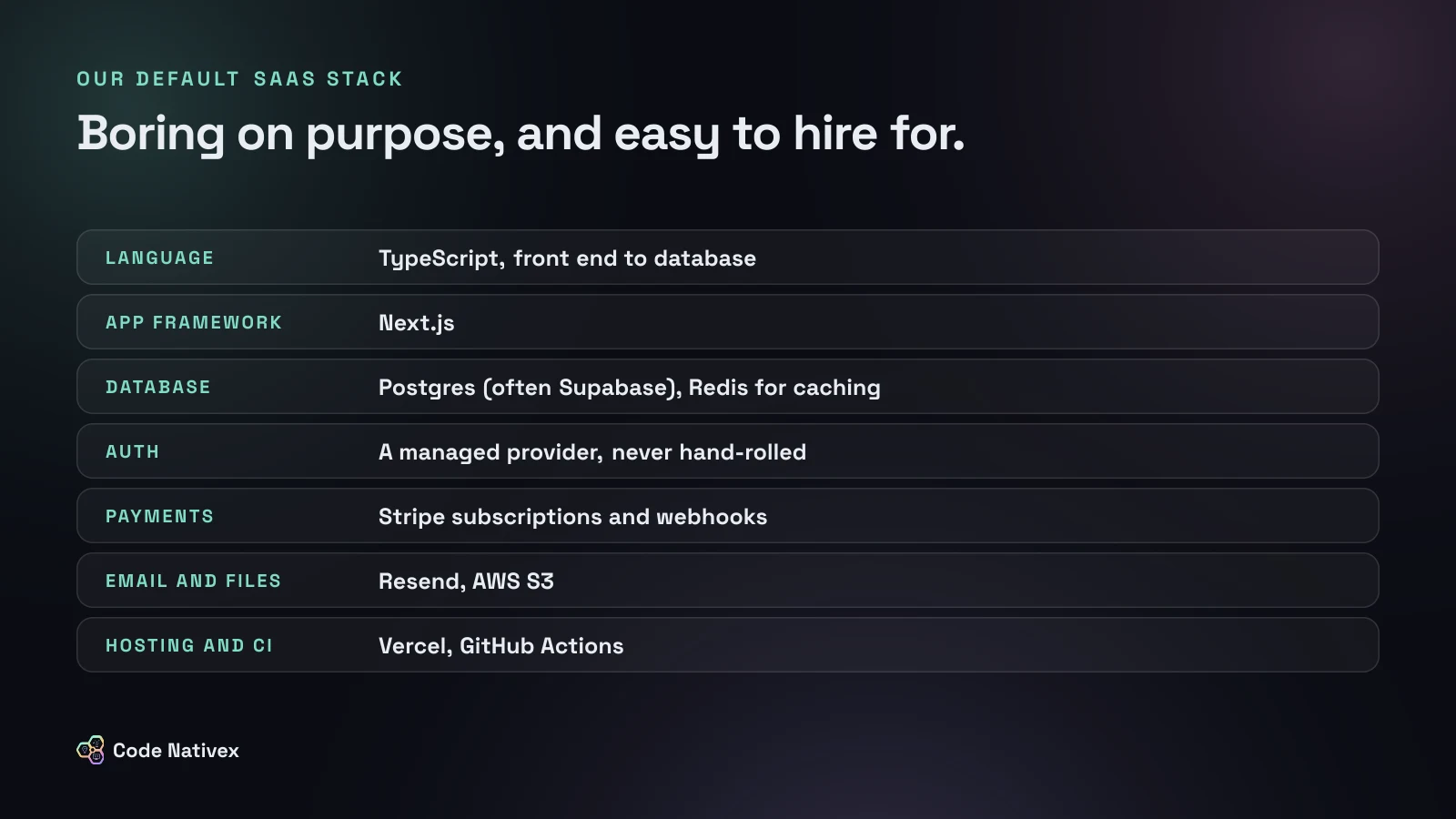
The stack at a glance
- Language: TypeScript everywhere, front end to database queries.
- App framework: Next.js, for pages, API routes, and server-side logic in one deployable app.
- Styling: Tailwind CSS, driven by design tokens from the Figma file.
- Database: Postgres, usually managed through Supabase, with Redis for caching and rate limits.
- Auth: a managed provider, never hand-rolled.
- Payments: Stripe for subscriptions, invoices, and webhooks.
- Email: a transactional email API such as Resend.
- Files: object storage such as AWS S3.
- Hosting and CI: Vercel for the app, GitHub Actions for tests on every pull request.
- AI, when needed: a hosted model API behind a thin service layer.
None of these are exotic. That is the point. Boring tools have good documentation, large communities, and plenty of developers who already know them.
Why TypeScript and Next.js
One language across the whole product removes a lot of friction. The same types describe a database row, an API response, and a form, so a renamed field breaks the build instead of breaking production.
Next.js gives us server-rendered marketing pages that load fast and rank well, an authenticated app, and API routes in one codebase with one deployment. Early on that means fewer moving parts. Later, when a part of the system genuinely needs its own service, it can be split out.
Why Postgres
Almost every SaaS product is relational underneath. Customers belong to organizations, organizations have subscriptions, subscriptions produce invoices, and every important change should leave an audit record. Postgres enforces those relationships with foreign keys and constraints, and transactions make sure a payment and its records update together or not at all.
For multi-tenant products, Postgres row-level security lets the database itself guarantee that one customer can never read another customer's rows, even if application code has a bug.
We saw the cost of the alternative on the America Working subscription platform: more than 240,000 records with real relationships between them. A relational database made the migration and the reporting straightforward instead of a constant fight.
Rent everything that is not your product
Auth, payments, email, file storage, and hosting are solved problems. Building them yourself costs weeks and adds security risk without making your product better. A managed auth provider handles password resets, social login, and session security. Stripe handles proration, failed payments, taxes, and invoices. Your engineering time should go into the workflows your customers pay you for.
Let Stripe webhooks own access
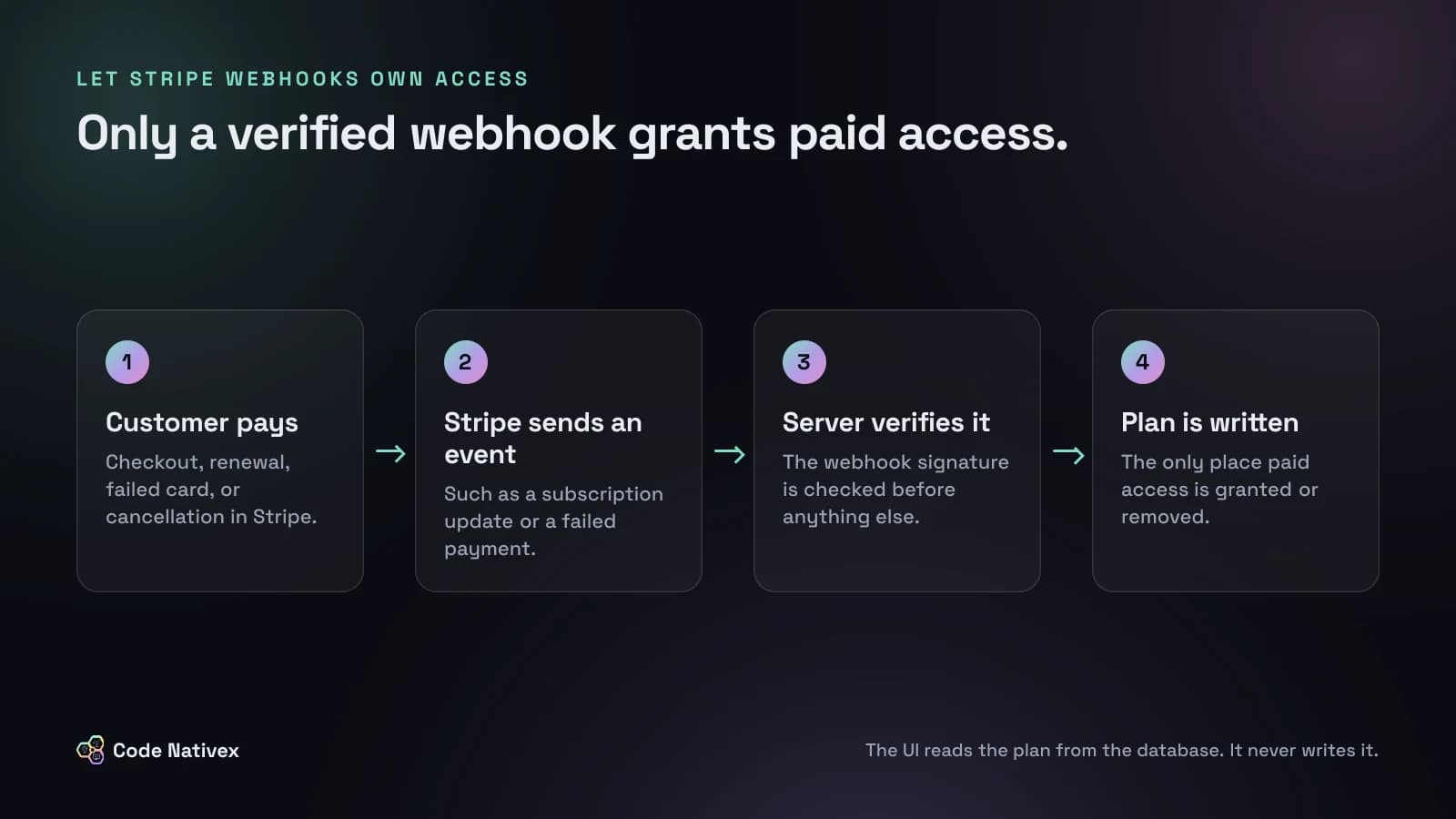
Billing bugs are the most expensive bugs in SaaS. One rule prevents most of them: the browser never decides what a customer has paid for. Only Stripe's webhook events grant or remove paid access, after the signature is verified.
// app/api/stripe/webhook/route.ts
import Stripe from "stripe";

const stripe = new Stripe(process.env.STRIPE_SECRET_KEY!);

export async function POST(req: Request) {
  const event = stripe.webhooks.constructEvent(
    await req.text(),
    req.headers.get("stripe-signature")!,
    process.env.STRIPE_WEBHOOK_SECRET!,
  );

  if (event.type === "customer.subscription.updated" || event.type === "customer.subscription.deleted") {
    const sub = event.data.object as Stripe.Subscription;
    // The only place entitlements are written.
    await setPlan(sub.customer as string, sub.status === "active" ? planFor(sub) : "free");
  }
  return new Response(null, { status: 200 });
}
The UI reads the plan from the database. It never writes it. That one boundary means a refund, a failed card, or a cancelled subscription always ends in the right state.
Quality is part of the stack
A stack is not only frameworks. Three habits keep a SaaS codebase healthy as it grows:
- Tests on every pull request. A fast unit test runner such as Vitest, run by GitHub Actions, catches regressions before review.
- A preview deployment per branch. Every change gets its own URL, so the client and the team can click through real flows before anything reaches production.
- Typed database access. Queries and migrations checked by TypeScript turn schema mistakes into build errors instead of support tickets.
What about MERN?
The MERN stack (MongoDB, Express, React, Node.js) earned its popularity: one language, a huge talent pool, and flexible documents that let early products change shape without migrations. It is still a good fit for document-shaped data such as content platforms and activity feeds.
The trade-off appears as a SaaS product matures. Billing, permissions, and reporting are relational problems, and on a document database teams often rebuild joins and constraints in application code. Next.js with Postgres keeps the single-language benefit and avoids that rework.
When we choose something else
- Content-first marketing sites with little interactivity can be simpler on a static-first framework.
- Document-shaped data can justify MongoDB.
- Heavy realtime or data processing can justify a dedicated service in another language, alongside the main app.
- Mobile apps usually pair this stack with React Native so web and mobile share code. We cover that choice in Flutter vs React Native for startups.
How to choose your own stack
Ask these in order: What shape is your data? Who will maintain it in two years? What must be true at launch: payments, compliance, offline support, search visibility? What can you rent instead of build? And how hard will it be to leave each vendor? Tools built on open standards keep your options open.
The bottom line
The best tech stack for SaaS is the one that fits your data and your team, and stays boring where boring is safe. For most products we build, that is TypeScript, Next.js, Postgres, and Stripe, with managed services around them. Our SaaS development service shows how we design, build, and launch products on this foundation.
Want a second opinion before you commit? Get a fixed-scope proposal and we will review your stack with you.
Frequently asked questions
- What is the best tech stack for a SaaS startup?
- For most SaaS products: TypeScript end to end, Next.js for the web app and APIs, Postgres for data, a managed auth provider, Stripe for billing, and managed hosting. It is fast to build with and easy to hire for.
- Is MERN still a good choice for SaaS in 2026?
- It can be, for document-shaped data such as content or activity feeds. For products with billing, permissions, and multiple customer accounts, a relational database usually saves rework later.
- Why Postgres instead of MongoDB for SaaS?
- Customers, subscriptions, invoices, roles, and audit logs all reference each other. Postgres enforces those relationships, supports transactions, and offers row-level security for multi-tenant data.
- Will we be locked into Supabase or Vercel?
- Not deeply. Supabase runs standard Postgres, and a Next.js app can run on other hosts. Keep auth and storage integrations behind clear boundaries in your code and migration stays a planned project, not a rewrite.
Written by
Tayyeb Ferozi
Senior full stack developer at Code Nativex, delivering full-cycle products from the database and backend to the user interface.
Meet the team