Klarna EU Subscription Changes: What SaaS Teams Must Do by November 20
From November 20, 2026, the revised EU Consumer Credit Directive changes how saved Klarna payments work for EU buyers. Renewals keep charging, but some move to Pay in Full, and on-session charges need a redirect. Here is what to check.
 Shumail RafiqueSenior Full Stack Developer
The Klarna EU subscription changes take effect on November 20, 2026, five days from now. If your SaaS product lets European customers pay for a plan with Klarna, saved Klarna payments will start behaving differently on that date, because the revised EU Consumer Credit Directive now covers some buy now, pay later products. This guide explains what changes for renewals and for charges made while the customer is present, who has to touch their code, a working example for Stripe's API, and the short checklist we would run this week.
What changes on November 20, 2026
The EU's second Consumer Credit Directive, Directive (EU) 2023/2225, applies from November 20, 2026. It replaces the 2008 directive and brings certain buy now, pay later products into consumer credit law for the first time. That means credit disclosures, creditworthiness checks, and rules on how credit is advertised.
For a merchant, the practical effect shows up in saved payment methods. Stripe's notice on Klarna future payments-regulation-update-november-20-2026-changes-to-klarna-future-payments) splits the change by whether the customer is in your checkout when you charge them:
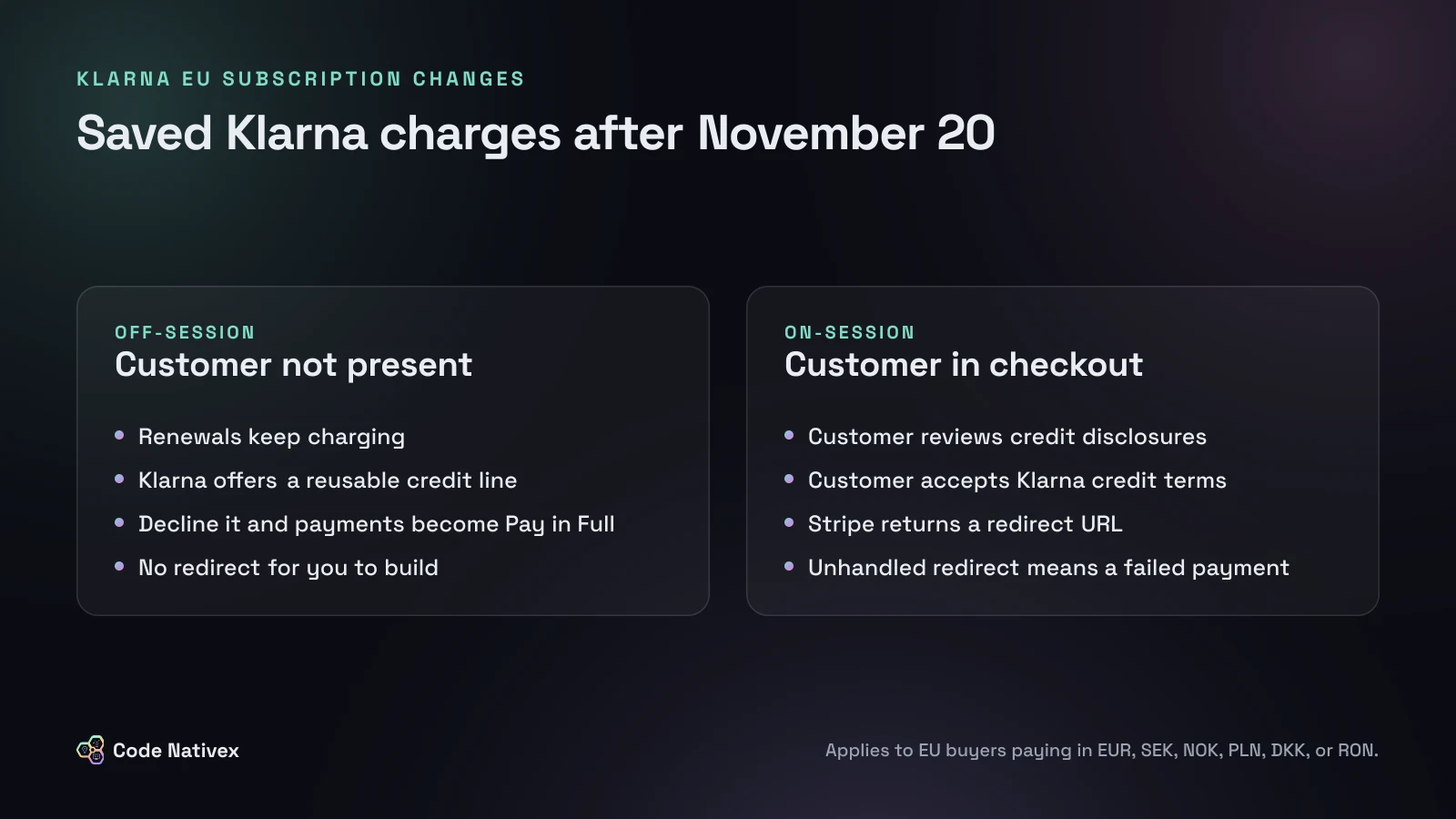
- Off-session (customer not present). Until November 20, every Klarna program is available for saved-method charges, including Pay in 3 and Pay in 30. After that, Klarna offers consumers a separate, reusable line of credit for new and existing subscriptions. If the consumer does not accept it, their subscription payments switch to Pay in Full.
- On-session (customer in checkout). The customer must review the required disclosures and accept Klarna's credit terms before paying. Stripe returns a redirect URL for that step, and if your integration does not handle it, the payment fails.
The scope follows the buyer, not the currency. Stripe lists EUR, SEK, NOK, PLN, DKK, and RON as the potentially affected currencies.
What it means for a subscription business
Start with the good news. Your monthly or annual renewals do not stop. Klarna, not you, asks the subscriber to accept the new credit line, and Klarna notifies buyers directly. If they say no, the renewal is charged in full instead of being split.
The cost is in the details that follow from that:
- Pay in Full surprises. A customer who was used to splitting an annual plan into three payments may now see one full charge. Some will email support. Some will dispute it. Stripe suggests telling them that Klarna contacts buyers directly and that the full charge reflects Klarna's compliance with the new EU rules. Put that answer in your support macros now.
- Upgrades and add-ons. Anything your app charges while the user is clicking a button, such as a plan upgrade, extra seats, or a credit top-up, is an on-session charge. Those now go through Klarna's terms screen. If your code treats a saved method as "charge and forget", those flows break.
- Revenue timing. For most SaaS teams the money still arrives. What changes is how some customers experience paying, and that shows up in support load and churn before it shows up in revenue.
If BNPL is a small share of your EU revenue, this is mostly a support and copy task. If it is a large share, test the full flow end to end before Friday.
Who has to change code
Stripe draws the line clearly:
- Stripe Optimized Checkout Suite users: Stripe says no action is required.
- Stripe API users with Klarna subscriptions or saved Klarna methods for EU buyers: review your integration before November 20, so customers can complete any Klarna step needed for future payments.
In practice, the teams at risk are the ones that built their own billing UI on Payment Intents or Setup Intents, often because they needed custom proration, seat-based pricing, or usage billing. That is common in SaaS. It is also exactly where a "charge the saved method" helper written two years ago assumes there will never be a redirect.
Other billing platforms that sit on top of Stripe, such as Chargebee or Recurly, have their own Klarna behavior, so check their notes as well as Stripe's.
Handling the on-session redirect in Stripe
Stripe's guide to future Klarna payments now carries a note on these reforms. For affected on-session payments, Klarna requires step-up authentication on the saved method, so the customer must be present for you to redirect them. For affected off-session payments, Klarna converts existing tokens to Pay in Full on its own.
The pattern for an on-session charge is: confirm the PaymentIntent with off_session: false and a return_url, then check whether Stripe wants a redirect.
import Stripe from "stripe";

const stripe = new Stripe(process.env.STRIPE_SECRET_KEY!);

// Charge a saved Klarna method while the customer is in the app.
export async function chargeSavedKlarna(customer: string, paymentMethod: string, amount: number) {
  const intent = await stripe.paymentIntents.create({
    amount,
    currency: "eur",
    customer,
    payment_method: paymentMethod,
    confirm: true,
    off_session: false,
    return_url: "https://app.example.com/billing/klarna-return",
  });

  if (intent.status === "requires_action" && intent.next_action?.type === "redirect_to_url") {
    // Send the browser here. Klarna shows its terms, then returns to return_url.
    return { redirectTo: intent.next_action.redirect_to_url?.url };
  }
  return { status: intent.status };
}
Three details matter here:
- 1.The client must follow the redirect. If you confirm with Stripe.js on the client instead, it handles the redirect for you. If you confirm on the server, return the URL and navigate to it.
- 2.The return page must check status. When the customer comes back, retrieve the PaymentIntent and show the real result. Do not assume success from the redirect alone.
- 3.Webhooks are the source of truth. If the customer abandons Klarna's screen, Stripe sends
payment_intent.payment_failedand the intent goes back torequires_payment_method. Make sure that event reverts the upgrade or seat change you showed optimistically.
Stripe's guide also covers revocation: a customer can switch off a saved Klarna method in the Klarna app, which sends a mandate.updated event. If you do not handle it, your next renewal attempt hits a method that no longer works.
A five-step readiness checklist
This is the list we would run on a SaaS billing integration this week.
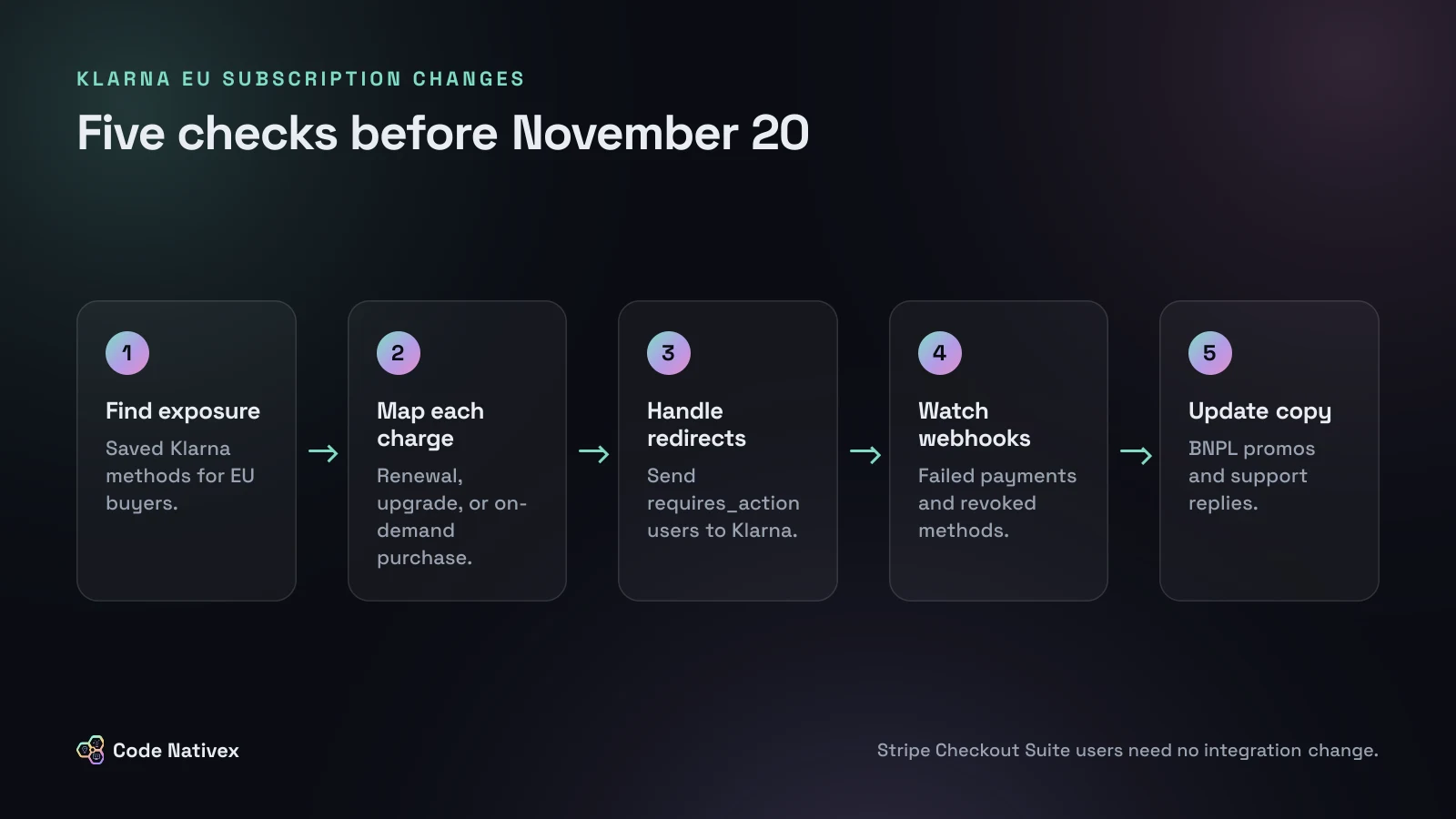
- 1.Find your exposure. Query Stripe for customers with a saved
klarnapayment method and an EU billing address. If the list is empty, you are mostly done. - 2.Map each charge type. For each place your code charges a saved method, write down whether the customer is present: renewal, upgrade, seat change, top-up, or one-off purchase.
- 3.Handle redirects on every on-session path. Use the pattern above, then test it in a Stripe sandbox, where you can simulate Klarna's redirect outcomes.
- 4.Check your webhooks. Confirm handlers exist for
payment_intent.payment_failed,setup_intent.setup_failed, andmandate.updated, and that they verify signatures. - 5.Update copy and support. Prepare an answer for customers who see a full charge. If you show BNPL messaging on your pricing page, review it too: Stripe's separate CCD2 note says advertising for BNPL products is also covered, and national rules can differ by country.
Teams that keep a local copy of Stripe data can find step one faster. We covered that setup in syncing Stripe data to Postgres, and the same webhook discipline applies to pausing Stripe subscriptions without losing state.
How we approach billing changes like this
We have built Stripe billing end to end for subscription products. For America Working, that meant checkout, plans, webhooks, and dunning, with custom delivery rules per subscription tier. For Capitalista, it meant multi-currency Stripe checkout with a webhook handler that keeps an investor dashboard in step with the ledger Stripe writes to.
The lesson from both applies here. Payment rules change from outside your product, often on a fixed date. The integrations that survive are the ones where Stripe's webhooks are the single source of truth, and where every charge path is written to expect that the customer may need to take an extra step. If your billing code assumes a saved method always charges silently, this change is a good reason to fix that assumption once, for every payment method.
If billing is core to your product, it belongs in the same plan as the rest of your SaaS development work, not in a one-off script.
Conclusion
The Klarna EU subscription changes are not an outage waiting to happen. Renewals keep charging, and Stripe's hosted checkout handles the new steps for you. The risk sits in custom API integrations that charge saved Klarna methods while the customer is present, and in support teams caught off guard by full charges. Find your exposure, handle the redirect, check your webhooks, and update your copy before November 20.
If you would like a second pair of eyes on your billing integration before the deadline, tell us about your setup and we will tell you honestly whether it needs changes.
Frequently asked questions
- When do the Klarna EU subscription changes start?
- They start on November 20, 2026, the date the revised EU Consumer Credit Directive (Directive (EU) 2023/2225) begins to apply. Stripe's notice uses the same date for changes to saved Klarna payments for EU buyers.
- Will my Klarna subscription renewals stop charging?
- No. For off-session renewals, Klarna offers the customer a separate reusable credit line. If the customer declines it, Klarna switches their subscription payments to Pay in Full, so the charge still goes through.
- Which customers are affected?
- EU buyers paying with a saved Klarna method. Stripe says the rule follows the buyer's profile, not the transaction currency, and lists EUR, SEK, NOK, PLN, DKK, and RON as the potentially affected currencies.
- Do I need to change my Stripe integration?
- If you use Stripe's Optimized Checkout Suite, Stripe says no action is required. If you charge saved Klarna methods through the API while the customer is present, you must handle the redirect Stripe returns, or the payment fails.
- Does this affect UK customers?
- The November 20 change is the EU rule. The UK has its own consumer credit reforms for BNPL, and Stripe documents a separate change for GBP Klarna payments, so check that guidance if you sell in the UK.
Written by
Shumail Rafique
Senior full stack developer at Code Nativex, building scalable web applications with modern technologies.
Meet the team