Stripe's OpenRouter Acquisition: What It Means for SaaS Teams Building With AI
Stripe now owns OpenRouter, the gateway that routes AI requests across hundreds of models. Here is what changed, what did not, and how to decide whether your product should use a model gateway at all.
 Raja ZiafatCEO & Founder
On November 10, Stripe said that OpenRouter is now officially part of the company, closing a deal first announced in August. The Stripe OpenRouter acquisition puts the company that processes payments for millions of businesses in charge of one of the most widely used AI model gateways. For a SaaS team building AI features, it raises two practical questions: should you route model calls through a gateway at all, and what changes when the same company handles both your AI spend and your billing? This guide covers what was announced, what OpenRouter does, the trade-offs of using a gateway, and how to set one up so you stay in control.
What was announced
Stripe first announced the agreement on August 19, 2026. Its newsroom post describes OpenRouter as an AI model gateway and routing platform that helps businesses route and optimize token usage across 400+ models from more than 80 providers, and names NVIDIA, Zoom, and Lovable among its users. Stripe's CEO, Patrick Collison, put the reasoning in one line: "Tokens are the central currency for companies building with AI."
On November 10, Stripe and OpenRouter confirmed the deal had closed. Neither company disclosed the price. OpenRouter said in August that its product, name, roadmap, and existing integrations would stay the same, and it says it remains neutral, with models and providers still competing on quality, reliability, and price.
What a model gateway does
A gateway sits between your app and the model providers. Instead of integrating each provider's API, your app sends one kind of request and the gateway decides where it goes:
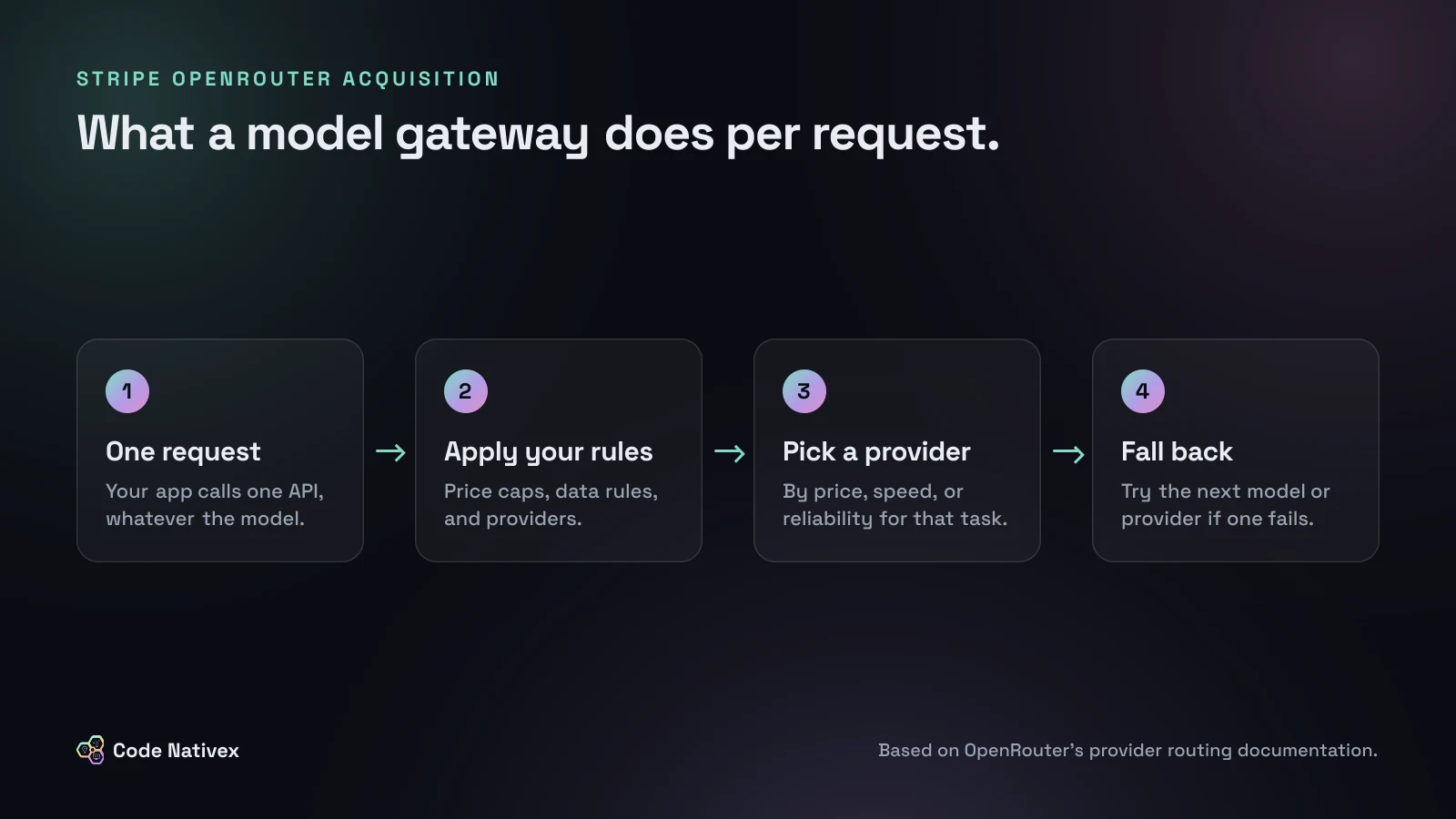
According to Stripe's announcement, OpenRouter evaluates each request and routes it based on task complexity, price, speed, and reliability. Its provider routing documentation shows the controls you get: preferred provider order, whether to allow fallbacks, maximum prices per million tokens, providers to allow or ignore, and data policies.
Why the deal matters for SaaS teams
Multi-model is now the default. A large payments company paying for a routing layer is a strong signal that most products will use more than one model: a cheap, fast one for simple tasks and a stronger one for hard ones. If your product is wired to one provider's SDK throughout the codebase, switching gets more expensive every month.
AI cost and billing are converging. Stripe has already launched products such as Token Billing for companies that charge for AI usage. With routing and billing under one roof, expect tighter links between what a request costs you and what you charge your customer. If you are deciding how to charge for AI features, our guide on how to price AI features in SaaS covers the options.
Concentration is a real risk. If the same company processes your payments and routes your AI traffic, an outage, policy change, or account review at that company affects both. That is not a reason to avoid it, but it is a reason to keep a way out.
Should your product use a gateway?
There is no single right answer. It depends on how many models you use and how much control you need over where data goes:
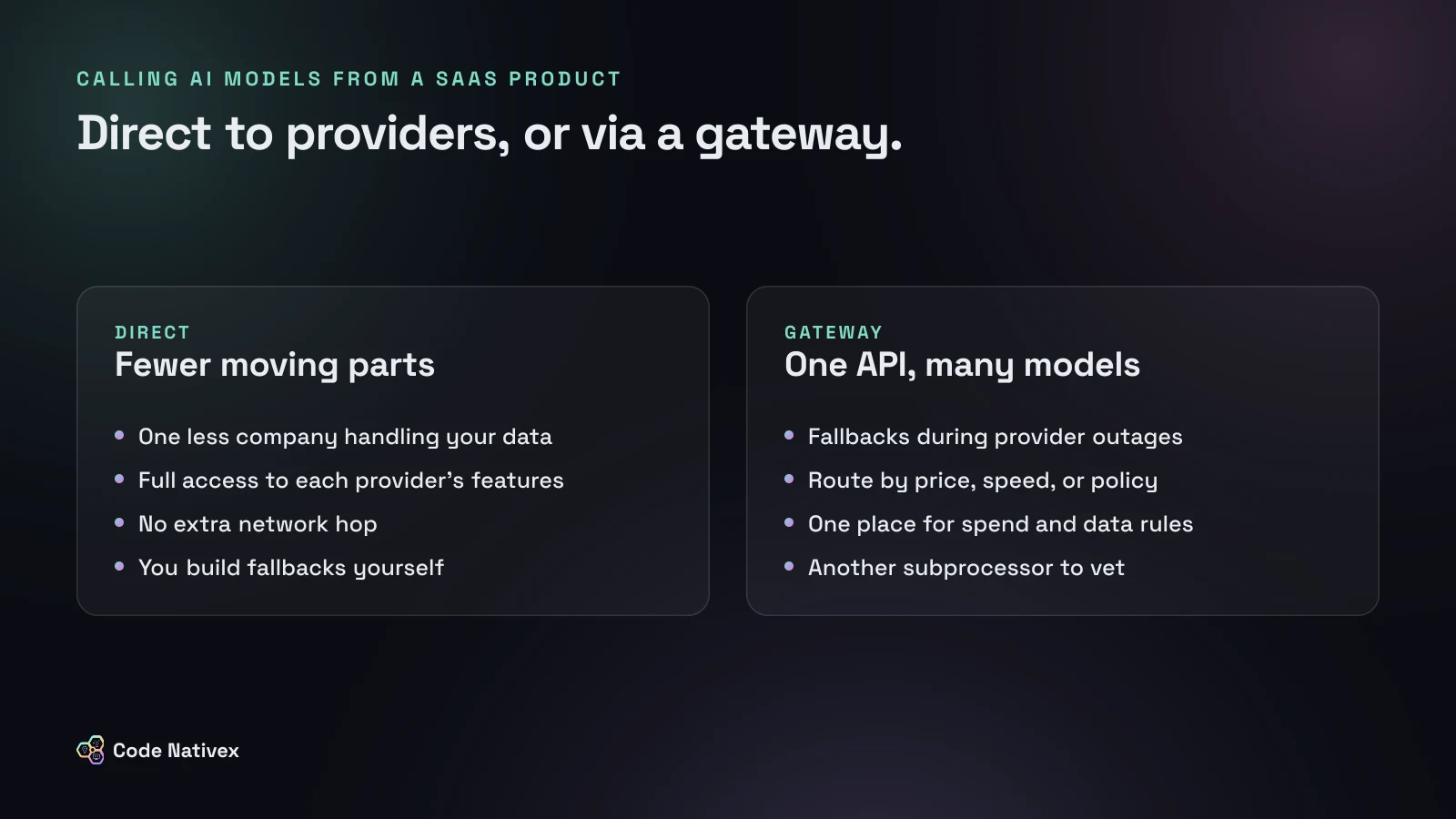
A gateway makes sense when you use several models, want automatic fallbacks during provider outages, want to route by price or speed per task, or need one place to set spend limits and data rules across teams.
Calling providers directly makes sense when you rely on one or two models, need provider-specific features as soon as they ship, want the fewest companies possible handling customer data, or have contracts that name specific processors.
Either way, a gateway is another company that sees your prompts and outputs. Add it to your data processing agreements and subprocessor list, just as you would a model provider. The Cloudflare GLM-5.3 data leak earlier this month is a reminder that every layer between your app and the model is a place where isolation can fail.
How to use a gateway and stay in control
If you do route through OpenRouter, set the rules explicitly rather than accepting defaults. OpenRouter's API works with the OpenAI SDK, so the setup is small:
import OpenAI from "openai";

const openrouter = new OpenAI({
  baseURL: "https://openrouter.ai/api/v1",
  apiKey: process.env.OPENROUTER_API_KEY,
});

export async function summarizeTicket(text: string) {
  const body = {
    models: ["anthropic/claude-sonnet-4.5", "openai/gpt-5-mini"], // fallback order
    input: `Summarize this support ticket in three bullet points:\n\n${text}`,
    provider: {
      zdr: true, // zero data retention endpoints only
      max_price: { prompt: 3, completion: 15 }, // USD per million tokens
    },
  };
  const response = await openrouter.responses.create(
    body as unknown as OpenAI.Responses.ResponseCreateParamsNonStreaming,
  );
  return response.output_text;
}
The models list gives an ordered fallback if the first model fails. The provider settings keep requests on zero data retention endpoints and cap what you will pay. OpenRouter also supports data_collection: "deny", to use only providers that do not collect user data, and only or ignore lists for specific providers. Its documentation warns that narrowing providers too far reduces your fallback options, so test the combination before production.
Questions to ask before you adopt a gateway
Whether you are evaluating OpenRouter or another gateway, get clear answers to these first:
- Data handling: Does the gateway store prompts or outputs, for how long, and can you turn that off? Which providers can it send your data to?
- Pricing: How does the gateway charge on top of model costs, and how will that appear on your invoice?
- Outages: What happens to your traffic if the gateway itself is down, not just a provider behind it?
- Contracts: Will it sign your data processing agreement, and which regions does it process data in?
- Exit: How quickly could you move to direct provider calls if your needs or its ownership change?
The last question matters more after an acquisition, because a new owner can bring new terms and priorities over time.
Keep it swappable
The most useful decision is not which gateway to use, but where the choice lives in your code. Put every model call behind one internal service, the approach we describe in our guide to adding AI features to an existing web app. Then a gateway, a direct provider, or a mix of both is a configuration change, not a rewrite.
That same layer is where you measure cost per feature and per customer, which our guide to reducing LLM API costs covers, and where you track response times, as described in our guide to reducing AI agent latency. A gateway adds a network hop, so measure it rather than assume.
How we build AI features for clients
We build AI features and agents so the model provider is a replaceable part: one internal service for model calls, clear data rules for what may be sent, and per-feature cost tracking from day one. Our AI agent development service covers the build, including the choice between direct providers and a gateway.
The bottom line
The Stripe OpenRouter acquisition makes one thing clear: AI usage is becoming a line item that companies route, meter, and bill like payments. For your product, the right question is not whether to use OpenRouter, but whether a gateway's fallbacks and routing rules are worth another company handling your data. Whichever you choose, set data and price rules explicitly, add the gateway to your subprocessor list, and keep every model call behind one internal layer so you can change your mind later.
Planning AI features for your product? Tell us about it and we will send a fixed-scope proposal.
Frequently asked questions
- Did Stripe buy OpenRouter?
- Yes. Stripe announced an agreement to acquire OpenRouter on August 19, 2026, and said on November 10 that OpenRouter is now officially part of Stripe. Neither company disclosed the price.
- What does OpenRouter do?
- OpenRouter is an AI model gateway. Your app sends requests to one API, and OpenRouter routes them across more than 400 models from over 80 providers, based on rules such as price, speed, reliability, and data policy.
- Will OpenRouter change after the Stripe acquisition?
- OpenRouter said in August that its product, name, roadmap, and existing integrations would not change, and it says its commitment to neutrality stays the same. Watch for changes to billing and pricing as the products come together.
- Should my SaaS use an LLM gateway?
- A gateway helps if you use several models, need fallbacks during provider outages, or want one place to enforce spend and data rules. Calling providers directly is simpler if you use one or two models and want one fewer company handling your data.
- Can I control where my data goes through OpenRouter?
- Yes. OpenRouter's provider settings let you route only to providers that do not collect user data, restrict requests to zero data retention endpoints, and allow or block specific providers.
Written by
Raja Ziafat
Founder and CEO of Code Nativex. Raja scopes every project with clients directly and leads the engineering behind the web, SaaS, and AI products the team ships.
Connect on LinkedIn